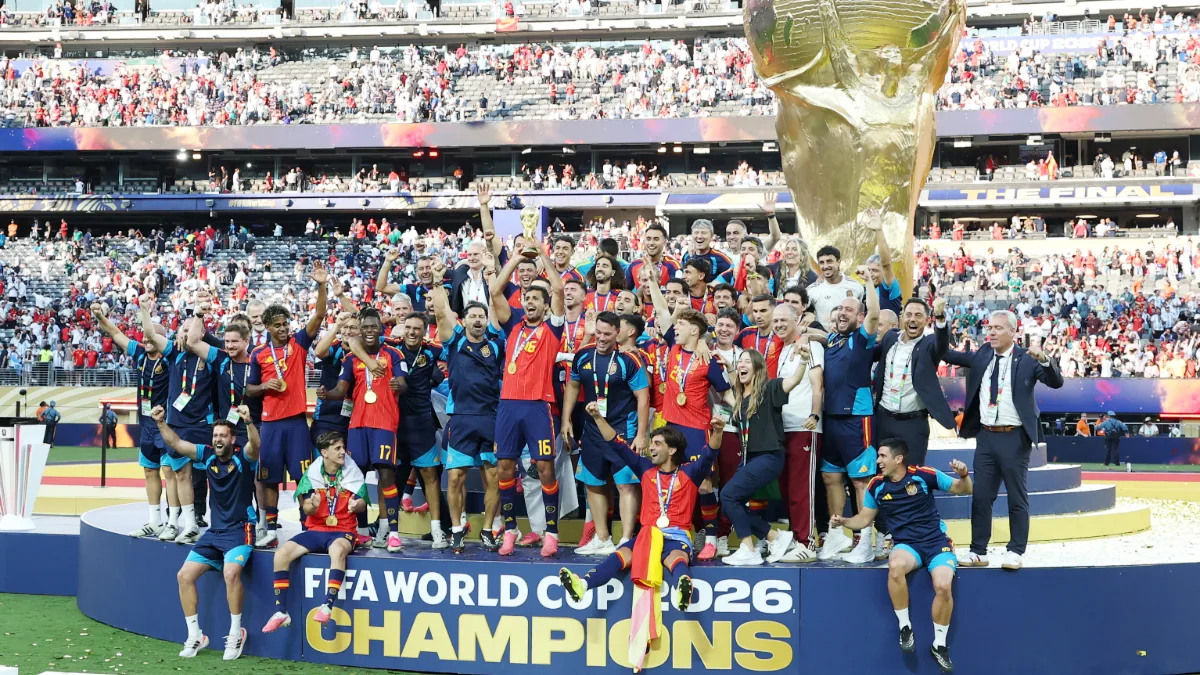
Spain’s triumph at the 2026 World Cup was more than the recovery of a crown last won in 2010. It may have marked a changing of the guard in international football. The embrace between 19-year-old Lamine Yamal and 39-year-old Lionel Messi after Spain’s 1-0 extra-time victory over Argentina captured that transition with an eloquence that the match itself rarely achieved. Messi may have made his final World Cup appearance. Yamal, already a European champion, has now won football’s greatest prize before his 20th birthday. Yet Spain’s achievement is larger than the emergence of another prodigy.
The country simultaneously holds the men’s World Cup, European Championship and Olympic titles, alongside the women’s World Cup. Its senior men have gone 38 matches unbeaten. Such dominance suggests not a fortunate generation but a footballing system capable of continually renewing itself. The final demonstrated that strength. Spain had 65 per cent possession and subjected Argentina to sustained pressure, while the defending champions failed remarkably to register a shot during regulation time. Spain conceded only once throughout the tournament. Ferran Torres’s winner in the 106th minute therefore settled a contest whose narrow scoreline concealed a considerable disparity. Argentina’s response made defeat more damaging.
Advertisement
A team talented enough to reach consecutive finals too often substituted disruption for invention. Enzo Fernandez’s dismissal after a reckless challenge and the confrontations following the final whistle left an unworthy final impression of the outgoing champions. Physicality and tactical obstruction are legitimate instruments of competitive football; indiscipline is not. Argentina’s approach also marginalised their greatest asset, leaving Messi peripheral when his creativity was most needed. The contrast points towards divergent futures. Spain’s established core, led by Rodri, is already complemented by Yamal and Pau Cubarsi, both 19. Argentina must contemplate life after Messi, while coach Lionel Scaloni’s own future is uncertain.
Spain have achieved the difficult feat of combining supremacy with succession. Spain’s success also vindicates sustained investment in youth development, proving that international dominance is built long before players reach tournaments. There was another transition unfolding beyond the pitch. The 27-minute half-time entertainment, celebrity performances, elaborate ceremonies and President Donald Trump’s conspicuous presence alongside FIFA president Gianni Infantino gave the final the character of an American mega-event. FIFA appears increasingly attracted to the Super Bowl model, in which sport becomes one component of a much larger entertainment product.
That evolution promises greater audiences and commercial returns, but carries risks. Football’s global appeal has never depended on celebrity spectacle, and political prominence around trophy ceremonies can blur boundaries that sporting institutions should guard carefully. The enduring image of this final should therefore remain the simplest one: an ageing master embracing the teenager who may inherit his stage. Messi’s World Cup generation appears to be receding. Spain’s young champions are only beginning theirs. Amid all the fireworks surrounding modern football, the game itself supplied the more compelling spectacle.